Key Takeways
China has significant production capacity, but faces challenges in various sectors, such as low consumer confidence, high quality, and increasing tariffs, prompting the need for global investments. Overcapacity issues stem from the investment-driven growth model established over decades, causing supply-demand mismatches that date back to the 1990s.
The COVID-19 pandemic has exacerbated these imbalances, and the Chinese government is focusing on advanced manufacturing and green technology to create new growth drivers. While current overcapacity isn’t as critical as in 2016, it now impacts a broader range of sectors, including consumer goods, construction materials, and machinery.
- Solutions to overcapacity include boosting domestic demand and focusing on subsidizing consumption over construction. Ongoing policy shifts aim to stabilize the housing market, addressing the challenges posed by oversupplied sectors and enhancing household wealth reliant on real estate.
China has the capacity to produce more than it does, that this is not new, but that this time it applies to a wide range of sectors. Each solution to this imbalance has its drawbacks: boosting domestic markets, but Chinese consumers lack confidence; improving quality, but it is already high; exporting, but tariffs are increasing… and not only in the US. These difficulties call for greater Chinese investment worldwide.
China has long accustomed to an investment-driven growth model, which is central to its stellar economic growth over the past three decades. But it also makes the economy susceptible to supply-demand imbalances, leading to recurring episodes of industrial overcapacity. These can be traced back to the 1990s, when accelerated market reforms led to a glut of labor-intensive manufactured goods. A more recent episode occurred in 2014-2016, when the massive investment-led stimulus that followed the global financial crisis triggered an oversupply of construction materials.
During the Coface Country Risk Conference last February, we asked Agatha Kratz about the impact of industrial overcapacity on China:
A growth model that has reached its limits
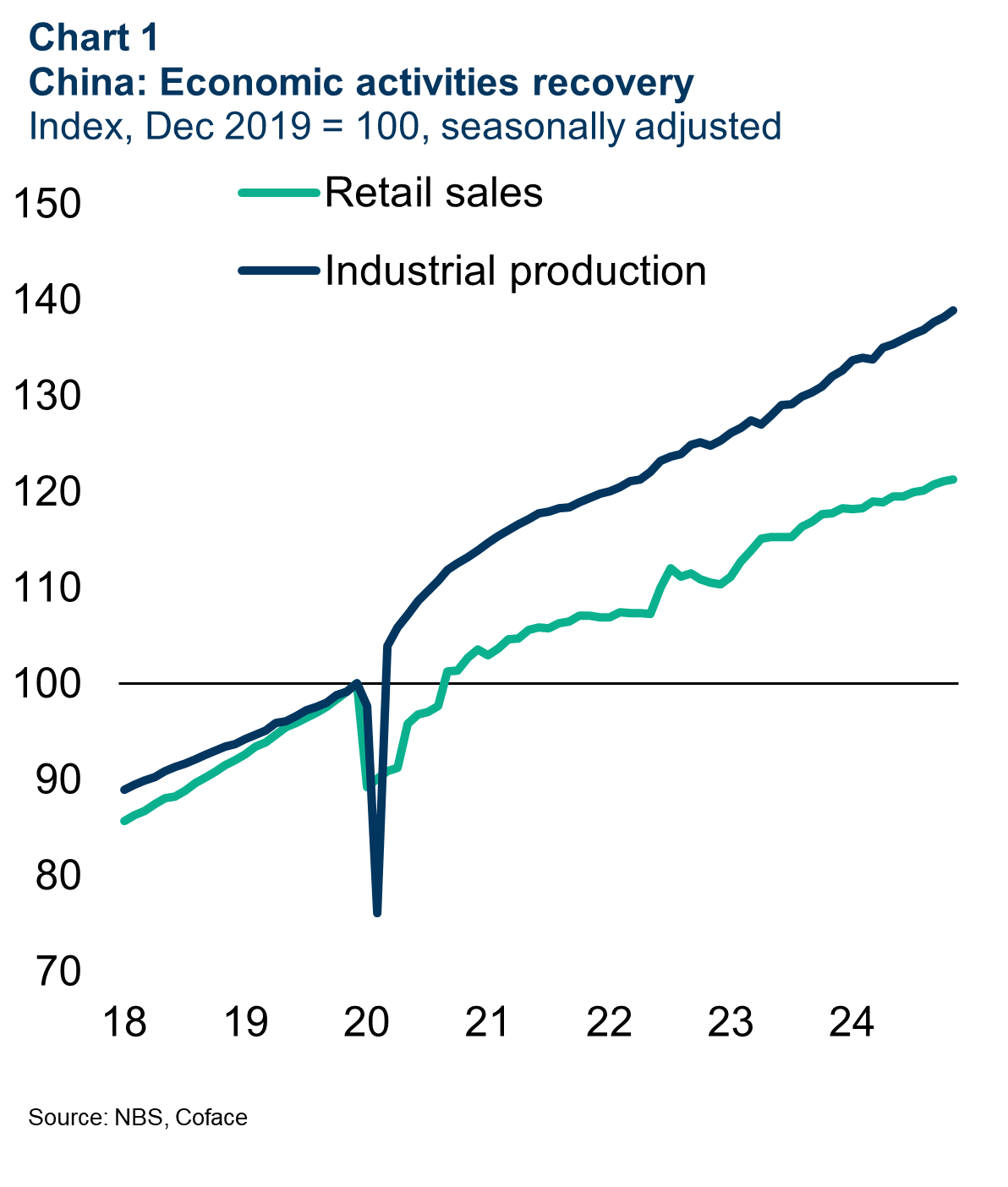
While this playbook is not new, the imbalances have become evident again since the COVID-19 outbreak (Chart 1), largely due to a production-driven stimulus approach aimed at reducing social interaction. Meanwhile, to pick up the slack from the shrinking housing market, the government has also proactively cultivated new growth drivers such as advanced manufacturing and green technology through state support.

Data for the graphs in .xls format
Overproduction with global consequences
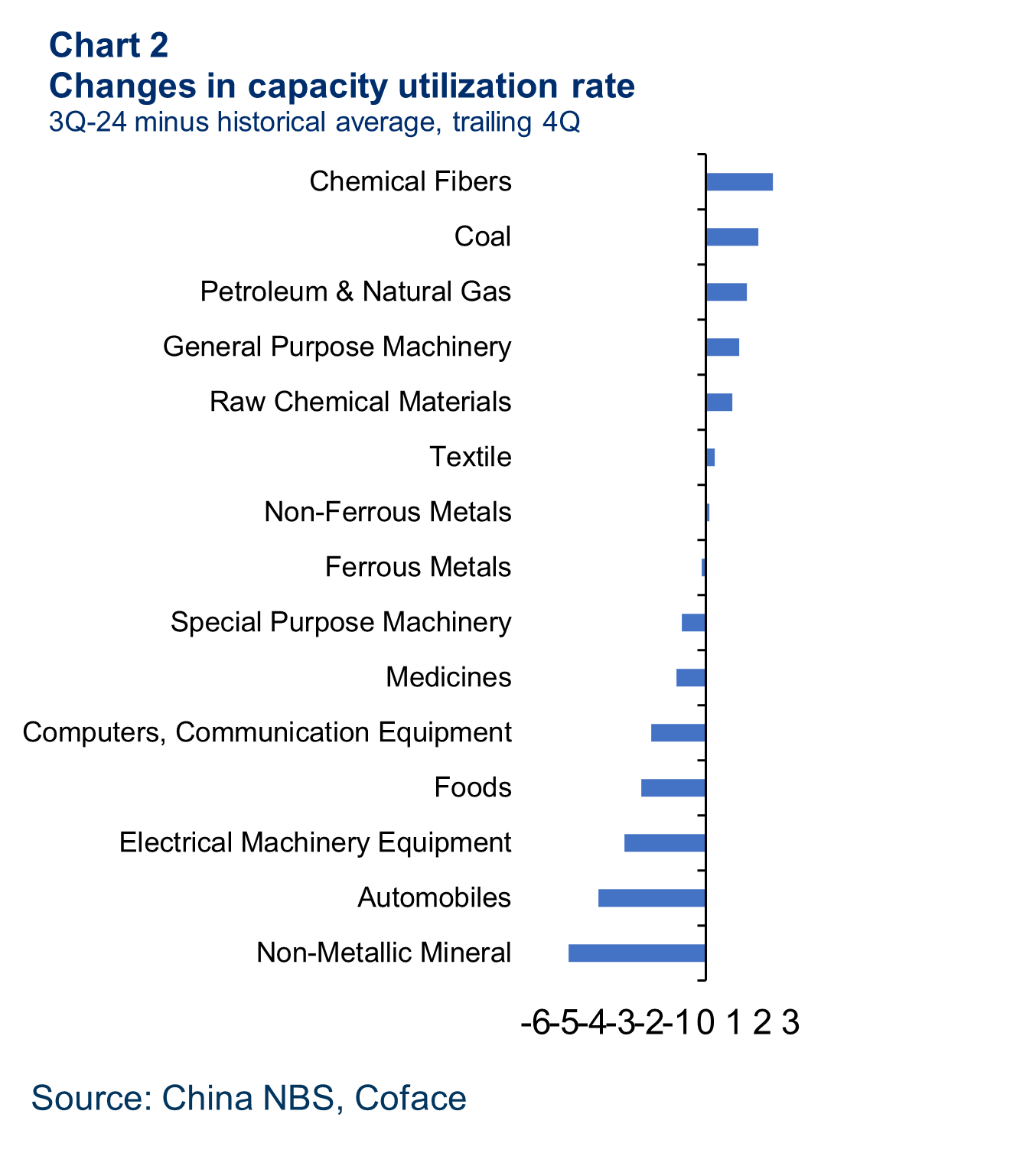
While the situation is not yet as severe as in 2016, overcapacity is prevalent in more sectors and faces more global pushbacks this time. It is no longer confined to specific sectors (labor-intensive consumer goods such as such as textile and home appliances in late 1990s, and construction materials such as steel and aluminum in the 2010s). This time, it has spread across traditional and emerging sectors. We see idle capacity most evident in consumer goods (food, medicine), construction non-metallic minerals (cement, glass), and machinery and transportation equipment (automobiles) (Chart 2). Our estimates show there is enough excess capacity in China to potentially double the exports of new energy vehicles and lithium batteries (Chart 3). But amid the global race of green transition, China’s production surplus in clean technology products has also made this round of overcapacity a focal topic globally and triggered more retaliations from trading partners.



Data for the graphs in .xls format
What solution to the Chinese overcapacity?
The most obvious solution to absorb excess production capacity is to expand domestic demand. Amid the ongoing supply-demand imbalance, recent policy focuses have shifted more towards subsidizing goods and facility consumption rather than construction. Meanwhile, efforts to stabilize the housing market have been made to curb the drag on household wealth given the substantial role of real estate in household…


