Key Takeways
The trade war between the United States and China has escalated dramatically, with tariffs exceeding 100% on imports from both sides, significantly increasing costs and threatening global trade. The potential for recession in both economies has risen, affecting international commerce.
President Trump views tariffs as a strategic tool for long-term benefits, such as financing tax cuts and reducing trade deficits. He is unconcerned about the impact on global trade, believing it exists primarily for US benefit.
- The looming crisis could lead to inflation reaching 4% and unemployment rising to 5-6%. A loss of confidence in US governance might provoke capital flight, further impacting the dollar’s value. In contrast, China may bolster its domestic market to mitigate tariff impacts, as internal sales constitute a significant portion of its economy.
The escalating trade war between the United States and China has reached a critical point, threatening to severely disrupt global trade. Reciprocal tariffs of over 100% are making trade between the two economic giants prohibitively expensive. The risk of recession, both for the US economy and the global economy, has increased significantly.
An unprecedented trade war
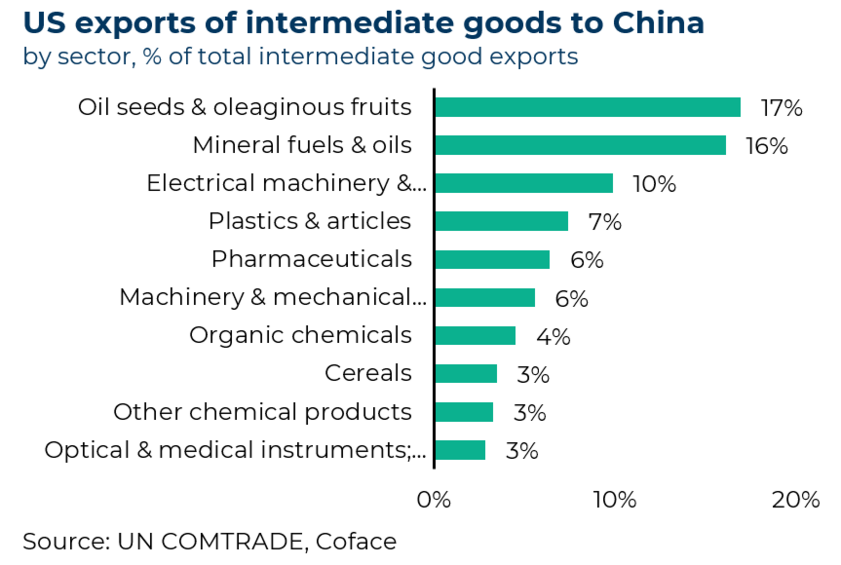
The trade war between the United States and China has reached unprecedented levels. After President Donald Trump announced widespread tariffs on 2 April, China retaliated with similar measures. Within a week, both countries had imposed additional tariffs of 125% on each other’s imports. The products affected include Chinese manufactured goods such as clothing and toys, as well as US exports such as agricultural products and high-tech equipment.
Tariffs at the heart of Donald Trump’s policy
Donald Trump has always maintained that the short-term cost of tariffs is very low compared to the long-term benefits. He sees them as a means of financing tax cuts, reducing the US trade deficit and attracting foreign capital to relocate manufacturing. Breaking off trade relations with a surplus economy like China is fully in line with this strategy. The risk of a collapse in trade between the US and the rest of the world is not a concern for Donald Trump, who believes that global trade exists solely to benefit the US.
The United States faces the risk of recession
Despite progress in decoupling, trade between the United States and China remains a central pillar of the global economy. A collapse in imports caused by tariffs would lead to a dramatic increase in the prices of manufactured goods or make certain imported products completely unprofitable, causing them to disappear from the US market. Disruptions to supply chains could affect key sectors such as automotive, chemicals and electronics. Inflation could reach 4% by the end of the year, and unemployment could climb to 5-6%, plunging the economy into recession.
Worst-case scenario: crisis of confidence, capital flight and collapse of the US dollar
A more serious scenario would be a loss of confidence in US governance, which could trigger a sustained capital flight and a balance of payments crisis. The latest indicators point in this direction and make this scenario increasingly likely. Since 2 April, the US dollar has fallen from 0.93 to 0.88 against the euro, and Treasury yields have jumped 50 basis points. Since the beginning of the year, the S&P 500 has lost 7.6% of its value. These are all signs that capital has been flowing out of the country.
Domestic market support as China’s response to tariff uncertainties
For China, the tariff shock could be partially offset by domestic stimulus measures. Domestic sales still account for 81% of industrial companies’ turnover, while direct exports to the United States account for only 2.7%. The domestic market therefore remains a crucial pillar, and the Chinese government (at the next Politburo meeting in late April) could step up subsidies and support measures for affected SMEs and exporters. However, persistent external uncertainties could weaken the…

