
 Study of 329 Patients in Europe Shows Superior Performance Compared to Microscopic Diagnosis Sensitivity: 94.4%, Specificity: 97.2%, Agreement Rate: 92%
YONGIN, South Korea, Sept. 24, 2024 /PRNewswire/ — Noul Co., Ltd. (CEO: David Lim, hereafter referred to as "Noul") has proven the expert-level diagnostic performance of its AI in Europe. Noul presented the AI diagnostic performance results of miLab at the 2024 International Congress for Tropical Medicine and Malaria. The study, conducted by National Center for Microbiology of Carlos III Health Institute in Spain, showed a sensitivity of 94.4%, specificity of 97.2%, and a concordance of 92% compared to microscopic diagnosis.
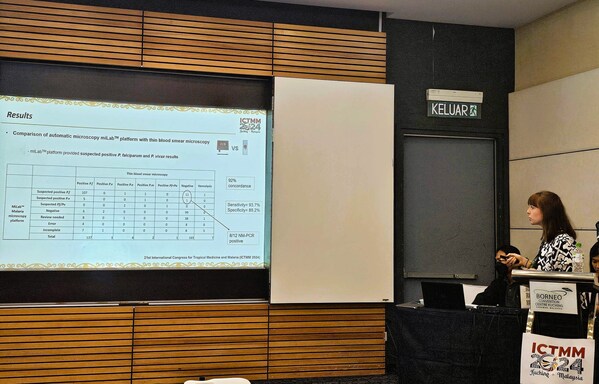 Noul Demonstrates ‘Expert-Level’ AI Diagnostic Performance in Europe… Results from Spain’s Carlos III Health Institute
The study was led by the Spanish National Malaria Reference Laboratory at National Center for Microbiology of the Carlos III Health Institute to evaluate miLab, an on-device AI-based solution that fully automates the malaria diagnostic process. Blood samples from 329 patients with suspected malaria were collected, and the diagnostic results of miLab AI were compared with thin blood smear microscopy.
The study revealed that miLab AI demonstrated a sensitivity of 94.4% and a specificity of 97.2%, with a concordance of 92% compared to microscopic testing. Of the 12 mismatched samples, 8 were confirmed as false negatives by microscopy. This indicates that miLab’s AI performance is superior when compared to standard diagnostic methods.
Additionally, it was noted that miLab can provide quantitative parasitemia. Through analysis of 100K~300K red blood cells, which is more than 100 times more than the number checked by microscopists, it is possible to provide a more reliable parasitemia level estimate.
Dr. Jose Miguel Rubio, Head of the Malaria and Emerging Parasitic Diseases Laboratory of the National Center for Microbiology at Carlos III Health Institute, who led the study, stated, "To eliminate malaria globally by 2030, new technologies that surpass the limitations of existing diagnostic methods are required. miLab, an on-device AI-based solution that fully automates the malaria diagnostic process, showed excellent sensitivity compared to standard testing, making it a valuable tool for use in the field, even without the need of expert microscopists."
Recently, malaria cases in the U.S. and Europe have shown an increase in indigenous transmission, as opposed to the past, when most cases were imported from endemic regions. The World Health Organization (WHO) has warned that climate change poses a significant threat to malaria eradication. In 2021 alone, there were approximately 247 million malaria cases reported across 84 countries. This highlights the importance of establishing accurate and rapid malaria diagnostic and surveillance systems.
Meanwhile, Noul participated in the International Congress for Tropical Medicine and Malaria (ICTMM), a global conference aimed at collaborative efforts and multidisciplinary research for the eradication of tropical diseases. This year’s event is being held in Malaysia.
This content was prepared by our news partner, Cision PR Newswire. The opinions and the content published on this page are the author’s own and do not necessarily reflect the views of Siam News Network


