Key Takeways
-
The United States and Thailand have established a Framework for an Agreement on Reciprocal Trade to enhance their economic ties, providing exporters from both nations improved access to each other’s markets. This initiative builds on existing agreements, including the 1966 Treaty of Amity and Economic Relations and the 2002 Trade and Investment Framework Agreement.
-
Key provisions include Thailand’s commitment to eliminate tariffs on approximately 99% of goods, which encompasses a broad spectrum of U.S. industrial, food, and agricultural products.
-
The U.S. will maintain reciprocal tariffs at 19%, as defined in Executive Order 14257, while also identifying certain products to be eligible for a zero percent tariff rate under Executive Order 14346.
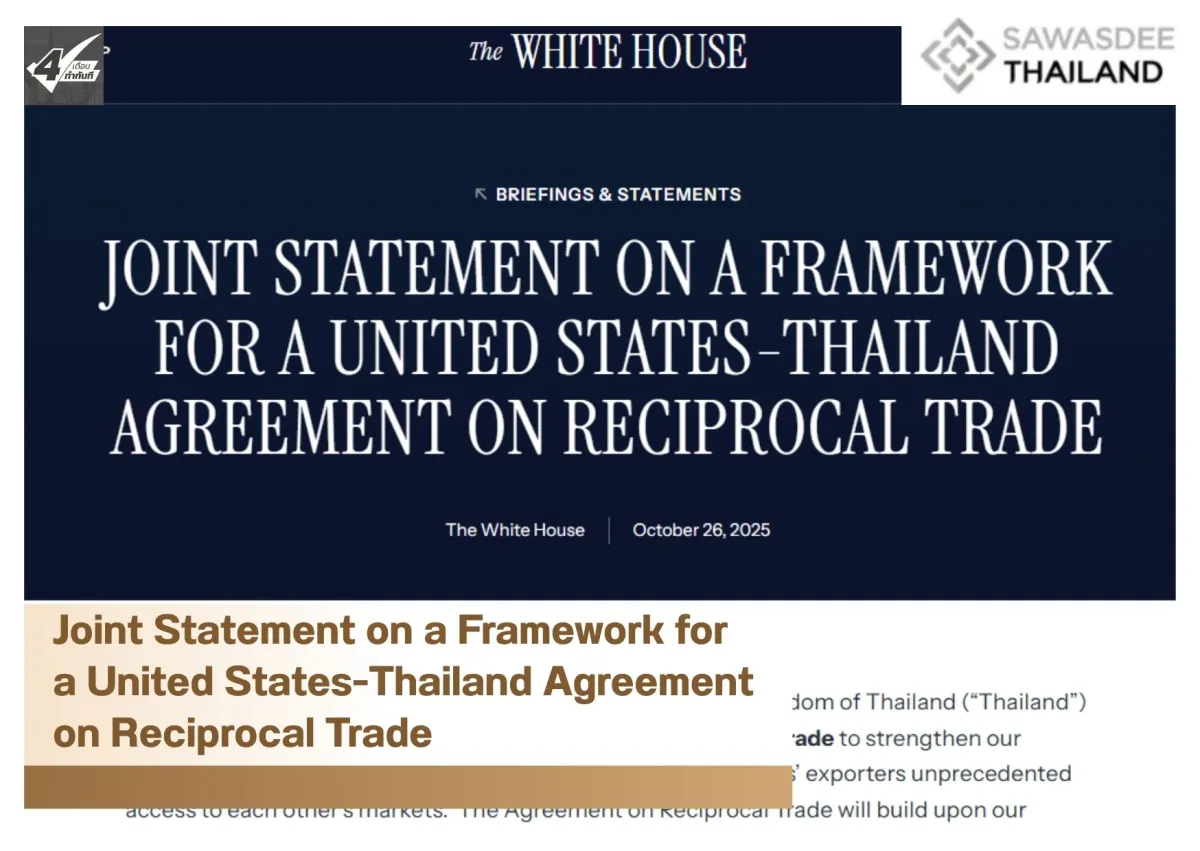
The United States of America (“the United States”) and the Kingdom of Thailand (“Thailand”) have agreed to a Framework for an Agreement on Reciprocal Trade to strengthen our bilateral economic relationship, which will provide both countries’ exporters unprecedented access to each other’s markets. The Agreement on Reciprocal Trade will build upon our longstanding economic relationship, including the U.S.-Thailand Treaty of Amity and Economic Relations, signed in 1966, and the U.S.-Thailand Trade and Investment Framework Agreement, signed in 2002.
Key terms of the Agreement on Reciprocal Trade between the United States and Thailand will include:
– Thailand will eliminate tariff barriers on approximately 99 percent of goods, covering a full range of U.S. industrial and food and agricultural products.
– The United States will maintain at 19 percent the reciprocal tariffs, as set forth in Executive Order 14257 of April 2, 2025, as amended, on originating goods of Thailand, and will identify products from the list set out in Annex III to Executive Order 14346 of September 5, 2025, Potential Tariff Adjustments for Aligned Partners, to receive a zero percent reciprocal tariff rate.


